A smart Hardware Plug‑and‑Produce solution for fast adaptation to changes on the shop floor
MODUL4R changes the equation for manufacturers by proposing a smart Hardware Plug‑and‑Produce solution that allows fast adaptation to changes on the shop floor with less engineering effort. It is based on a modular, reusable automation system in which software mirrors the factory structure and connects machines to the cloud for monitoring and data exchange.
The Concept
Our approach follows an object‑oriented development methodology based on the IEC 61499 standard. Throughout the project, we created reusable automation objects that require little to no parameterization, allowing them to be deployed quickly in real production environments.
Such an object is represented by a CAT (Composite Automation Type), a core concept within Schneider Electric’s EcoStruxure Automation Expert development environment. A key advantage of a CAT is that its HMI is embedded directly into the object itself, meaning the visualization only needs to be created once and is automatically reused for every instance.
Digital Representation of the Shop Floor
As part of Modul4r, we built a multi‑layer hierarchical structure that mirrors a real shop floor inside our software. Every layer and every object within this digital structure is modeled as a CAT, making the entire architecture modular, consistent, and highly reusable.
Building on this foundation, we introduced an additional development: the CPSizer (Cyber Physical Systemizer). The CPSizer connects to both legacy PLCs and IEC 61499‑based PLCs, creating an automated digital representation of the physical shop floor within our software environment.
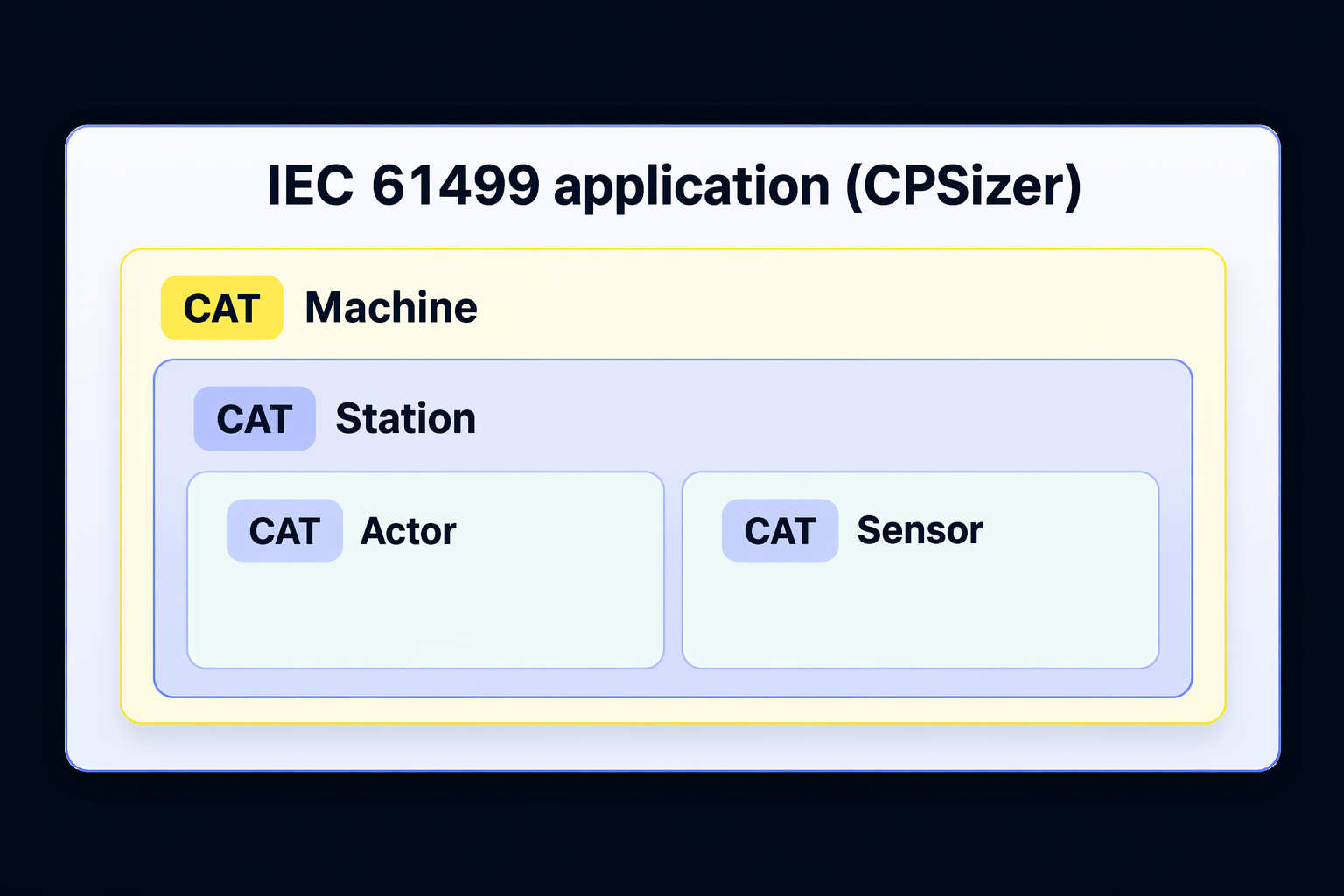
Beyond pure connectivity, the CPSizer also establishes an automatic MQTT‑based cloud connection, where all MQTT topics are generated directly from our object‑oriented structure. This means no manual configuration or engineering effort is required - topic generation and hierarchy emerge naturally from the system’s model. In addition, the CPSizer provides the capability to create and deploy control applications, leveraging the IEC 61499 standard to support distributed logic execution across multiple devices.
Bottom Line
With this combination of automated cloud integration, legacy‑friendly connectivity, and distributed control capabilities, the CPSizer serves as a powerful cyber‑physical bridge between real industrial hardware and our modular, software‑defined automation architecture.