MODUL4R advances data-driven design solutions for faster industrial reconfiguration
In high-complexity manufacturing environments, such as automotive, sheet-metal forming, tool making, and more, frequent and costly changes are major production bottlenecks that are difficult to ignore.
The MODUL4R project is developing data-driven design solutions to help manufacturers redesign, reconfigure, and optimize production processes faster and with greater confidence. This approach integrates design changes, simulation, process planning, execution, monitoring, and decision support into one traceable workflow, allowing teams to move from engineering problem to actionable production response with much less manual effort.
The value proposition here is clear: the technology supports the redesign and repair of metal parts and industrial components in a faster, more customizable way. It is also better connected to quality and process optimization needs.
Beyond Conventional Solutions
What makes this approach especially valuable is that conventional solutions often address only one piece of the problem, such as geometry editing, simulation, or shop-floor execution, but do not close the full loop between them. As a result, redesign cycles remain slow, knowledge stays fragmented, and workforce must spend time reconciling data from multiple systems, which increases cost and delays decisions. MODUL4R responds to that gap by centralizing product, process, and resource information and by making reconfiguration decisions more transparent and reusable.
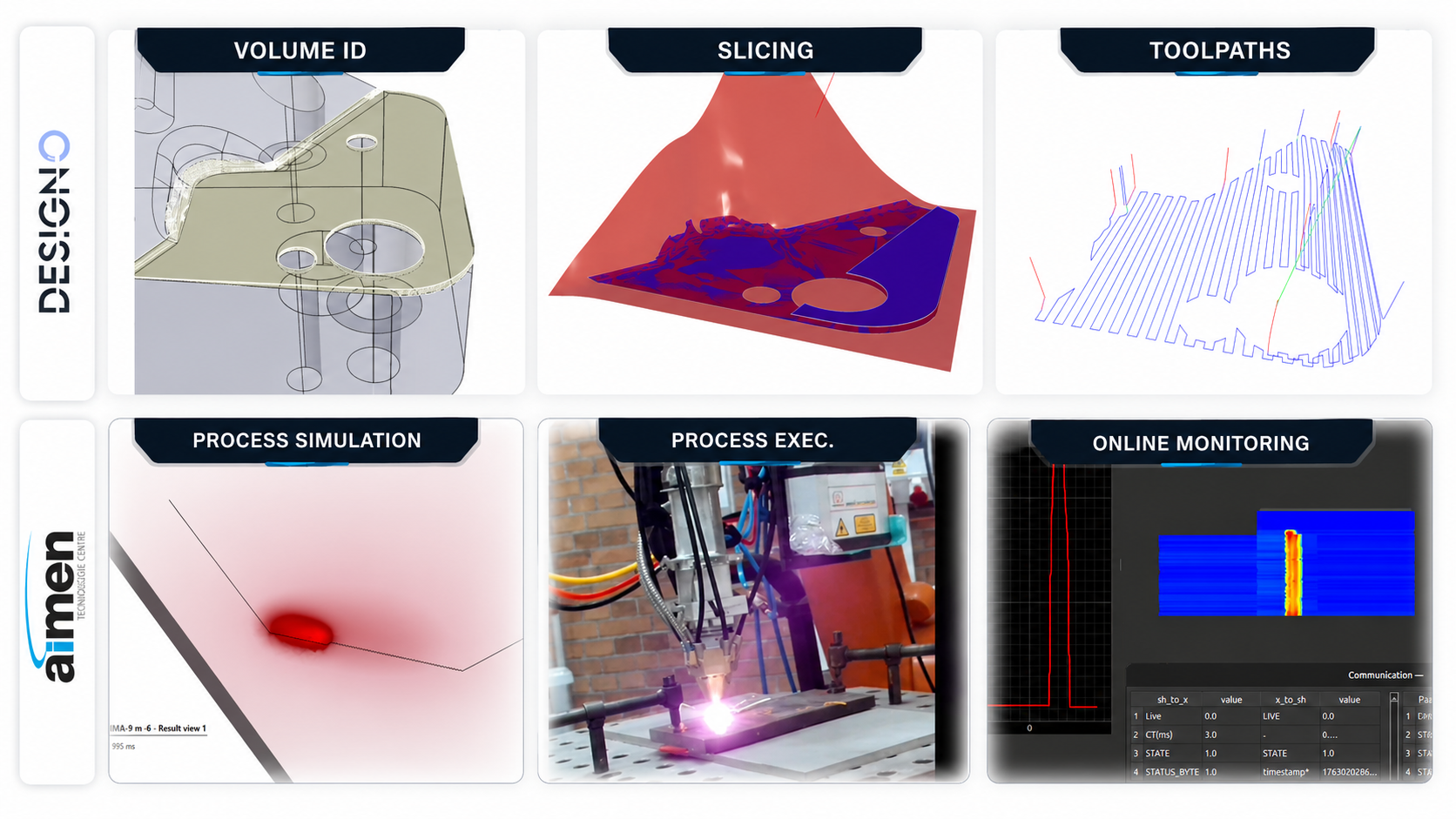
The Q-loop approach for line reconfiguration links differential volume identification, computer-aided process planning, simulation, manufacturing, and online monitoring through the QLoop App. This creates a digital quality loop where each iteration is traceable, configurable, and easier to validate, helping to reduce redesign cycles while preserving engineering knowledge across projects. The application ecosystem is online and browser-based, eliminating the need for complex and expensive stacks of multiple fragmented software suits and file formats, streamlining and organising all project data within a single enterprise or multiple actors.
Technological & Scientific Advancements Behind the Solution
The project combines explainable AI, counterfactual reasoning, process simulation, finite-element modelling, design of experiments, thermal and mechanical analysis, 3D metrology, sensor-data filtering, and real-time adaptive control for layer-height monitoring. In addition, the work shows strong system integration skills, including interoperable user interfaces, project traceability, MQTT-based event sharing, and human-in-the-loop workflow design.
Future Uptake
Our confidence in future uptake is high, especially in industrial niches where reconfiguration speed, traceability, and operator trust are critical. The solution is not a generic AI tool; it is a workflow-oriented capability that embeds expert knowledge into everyday engineering decisions, which makes adoption more realistic in companies that already work with complex parts, repair operations, additive manufacturing, or frequent production changes.
What makes MODUL4R particularly promising is that it addresses both technology and organization. It reduces the friction between design and production, but it also provides a business model that can support subscriptions, consulting, and ad hoc simulation services, with partnerships across industrial equipment, software, research, and integration ecosystems. That combination improves the chances that the solution can move from project demonstrator to practical industrial use.