Digital Assistant helps manufacturers reconfigure process chains faster & smarter
In today’s manufacturing environment, flexibility, modularity, and fast process-chain reconfiguration are becoming essential. Markets change quickly, customer requirements shift constantly, and supply-chain disruptions can affect production with little warning. For manufacturers, the ability to adapt process chains rapidly while keeping quality high and delays low is becoming a decisive competitive advantage. Manufacturing systems need to work effectively, production lines must be easy to reconfigure, while keeping costs, delays, and coordination problems under control. This is especially important for SMEs operating in low-volume, high-diversity production environments, where agility and responsiveness are critical for competitiveness. The MODUL4R Digital Assistant (DA), by ATLANTIS Engineering, was developed precisely to support this need, helping operators configure and optimize process production planning in a more agile and informed way.
Digital Assistant in Practice
Digital Assistant is an interactive tool that offers the user flexibility and adaptation to different manufacturing processes.
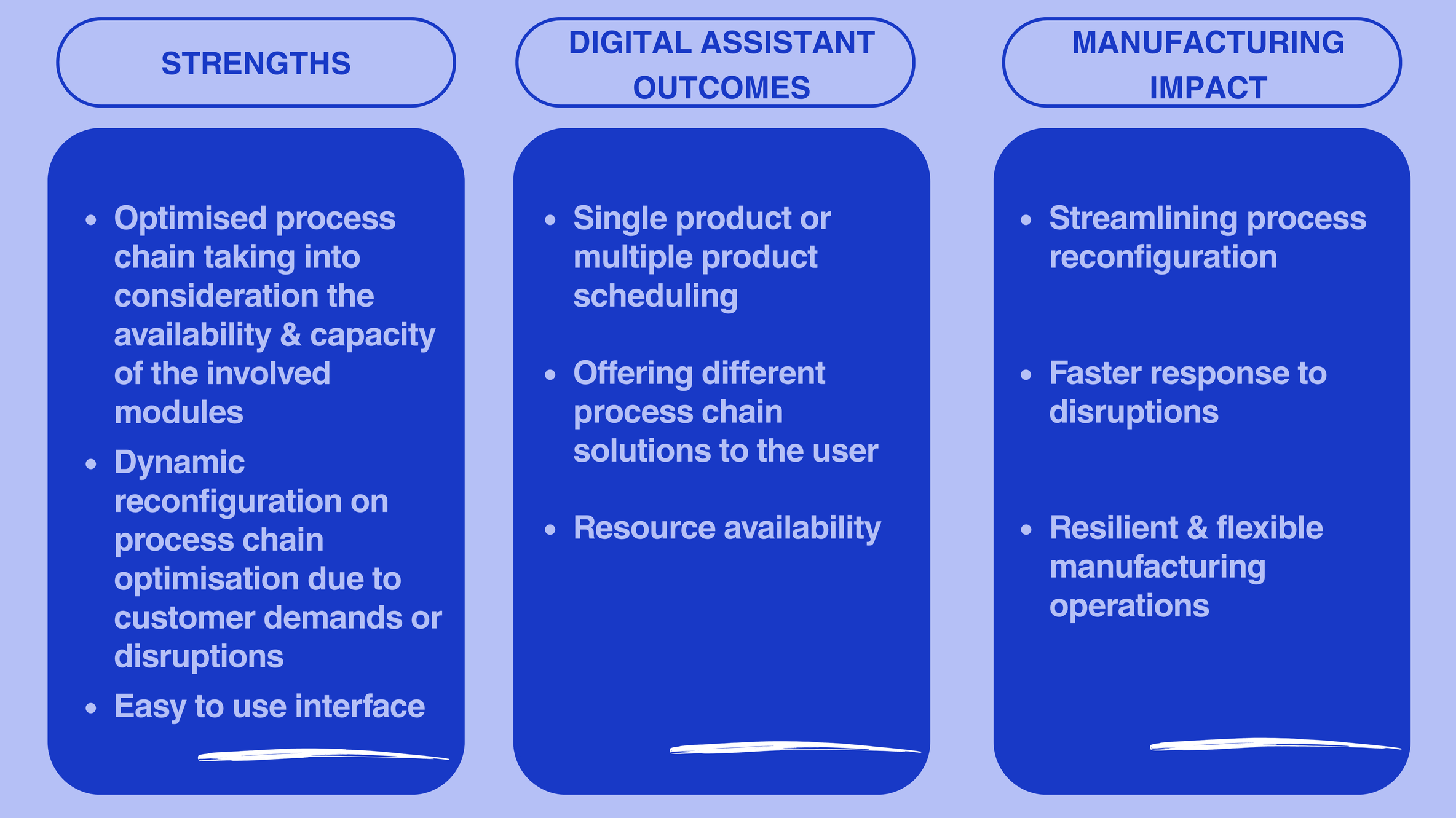
Τhe DA has been developed as a decision-support tool for the MODUL4R use case that focuses on highly customised taps for application in aero and windmill manufacturing. In this use-case, specialized tap cutting tools must pass through different production modules in different sequences. The solution models core production entities such as machines, robots, containers, part types, and orders using them for building an optimized process chain. Its output is not just a theoretical process reconfiguration, but an optimized combination of container size, robotic timing, and product sequence. Its easy-to-use interface and optimization engine allow the users to interact with the system, add or remove modules, parameterize conditions and configure scenarios for the production.
The implementation results showed that the total manufacturing time and energy consumption could be reduced.
Why it matters
The solution addresses a real industrial need. Specialized products may account for a relatively small batch, but a large share of revenue. These products can be highly customized, produced in lower quantities, and not fit easily into the regular production pipeline. The Digital Assistant, supported by its Risk Evaluation module, helps operators manage this complexity more effectively, supporting production automation, reducing time losses and manufacturing failures. More broadly, the tool responds to the wider need in manufacturing for better resource allocation, improved process step coordination and quicker production adaptation, directly improving a company’s ability to respond to demand or disruptions. By streamlining process chain reconfiguration and workflow decisions, the tool supports faster adaptation, better use of robotic cells, and more resilient, responsive and efficient manufacturing operations.
Scalability
The solution has been designed as a practical and adaptable tool for modular manufacturing environments, where production requirements, available resources, and process chains may change over time. Because it is built around configurable production elements and optimization-based decision support, it can be extended to accommodate new products, process steps, and operational conditions without losing its core functionality. Additionally, confidence in future uptake is also strengthened by the fact that the tool responds to a clear industrial need: helping manufacturers manage complexity, improve planning, and reconfigure production more efficiently. These are not isolated challenges, but common issues across many manufacturing settings, especially where production is modular, semi-automated, or subject to frequent change.
A Strategic Asset
Another point worth highlighting is that the Digital Assistant was designed as a modular and extensible platform rather than a one-off process chain tool. The UIs are designed to support adaptation to different manufacturing processes, not just a fixed use case. Users can configure modules, process paths, and scenario settings, while also including risk-related information such as failure probabilities for stress testing. This broader perspective increases its value as a future-ready planning assistant that can support not only productivity, but also risk awareness and sustainability-informed decision-making.
Bottom Line
Overall, the MODUL4R Digital Assistant represents an important step toward more adaptive and operator-centered manufacturing. It translates complex process chain problems into a usable web-based tool, combines optimization with simulation, and opens the door to future modular production environments.