Transforming automated PCB assembly using Digital Twin
In today’s electronics manufacturing, a rising demand for customized products is challenging traditional mass-production models. Automated assembly lines in electronics industry, such as Printed Circuit Boards (PCBs) assembly, excel in large-volume production, but they struggle to accomodate tailored products, and smaller batch sizes. As manufacturers increasingly seek to balance efficiency with flexibility, our MODUL4R researchers at Fraunhofer IWU (F-IWU) have developed a digital twin to bridge this gap.
The digital twin can optimize itself and take over control of the PCB assembly process. This technology is aimed at small and medium-sized companies with fluctuating batch sizes and many variants of printed circuit boards and electrical components.
Two Conflicting Priorities: Automation and Flexibility
While automated assembly is extremely efficient and cost-effective in mass production, it quickly reaches its limit with small and medium batch sizes and many variants. A high degree of automation is used in classic series production. Pick-and-place machines are optimized for large quantities and standardized product series. Once configured, production lines can run for a long time with minimal manual intervention, making them ideal for large series with identical PCB layouts.
However, flexible, customer-specific solutions are growing in demand in today's electronics production. Product life cycles shortening, the need for customized assemblies is increasing and developers are focusing on modular designs with a wide range of variants. For electronics manufacturing service providers, this means a constant stream of changeovers, new component types, modified layouts, and smaller production volumes.
For small batch sizes, the set-up costs are simply too high in relation to the production volume, which makes automated production economically unattractive. Manual assembly is therefore often used for small series production.
Our Approach
F-IWU proposes a shift from rigid production lines and manual adjustments to a more dynamic, data-driven manufacturing approach via a self-controlled process with a digital twin. This technology allows shorter set‑up times, higher quality and greater efficiency, especially in small series production with a high number of variants.
A time‑based and optimizing learning algorithm will be developed and implemented. This will enable the system to react to quality fluctuations (e.g., deformed pins) and adapt to changing product types. This self‑optimization feature is achieved through a continuous feedback loop between the physical process and its digital representation. The digital twin evaluates sensor data in real time, detects deviations in component geometry or placement accuracy, and automatically adjusts process parameters such as placement speed.
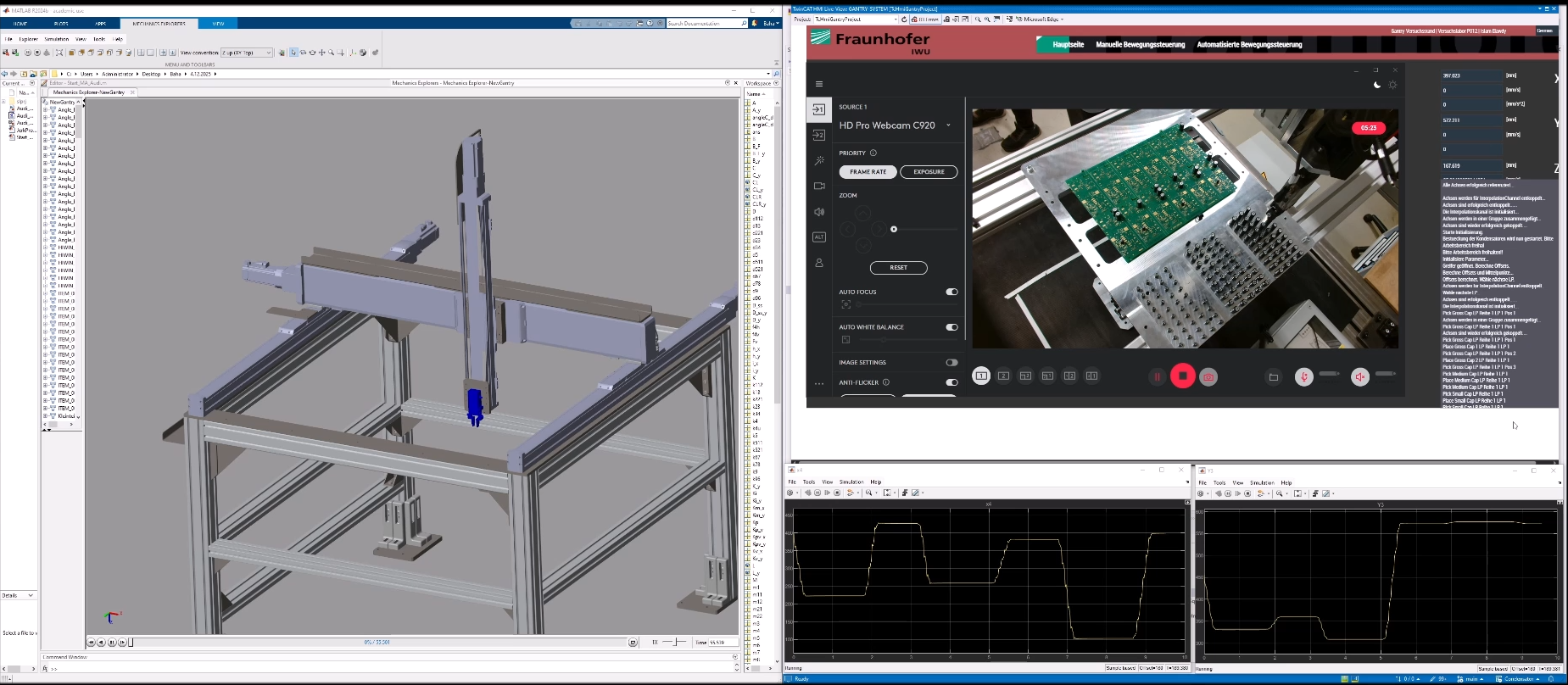
Instead of relying on fixed rules, the system learns from each assembly cycle. A key component of the digital twin is the adaptive process control. The production time is to be optimized iteratively, considering quality fluctuations in the components as well as inaccuracies caused by the device and robotics.
For manufacturers navigating increasingly complex and variable production requirements, such self-optimizing technologies could help make automation economically viable even beyond traditional high-volume manufacturing environments.