New Simulation Framework for the Modern Factory
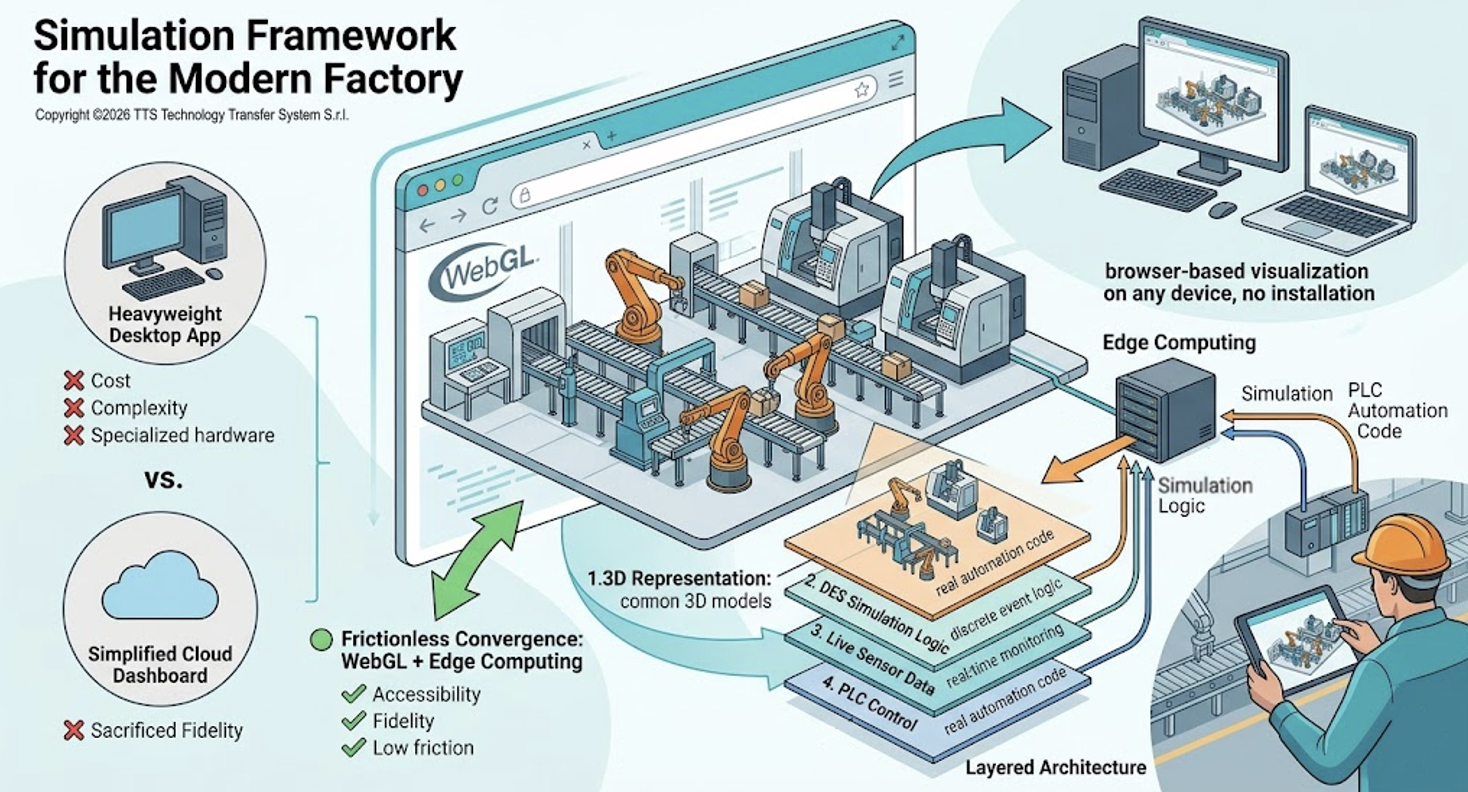
The simulation framework developed by TTS rethinks how industrial environments are modelled, visualised, and commissioned. At its core, the system renders a full three-dimensional virtual factory environment inside any standard web browser, powered by WebGL, the same graphics technology that drives modern web-based games and visualisations. The simulation logic runs on an edge node deployed close to the production floor, where it can interface directly with automation controllers, while the presentation layer is streamed to any device the user owns, whether it is a workstation, a laptop, or a tablet on the shop floor. No dedicated software installation is required. The result is a unified platform that can support simulation, remote monitoring, and automation code execution, all rendered within the same virtual environment.
Why it matters now
Industrial simulation is not a new idea, but the tools available today tend to fall into one of two camps: heavyweight, license-intensive desktop applications that require specialist hardware and trained operators, or simplified cloud dashboards that sacrifice fidelity for accessibility. Neither is well suited to the full lifecycle of a modern factory, which must evolve continuously from initial design through commissioning, steady-state operation, and eventual reconfiguration.
The problem this framework addresses is fundamentally one of friction. Every time a simulation model must be rebuilt from scratch, shared via proprietary file formats, or visualised on a machine that lacks the right software stack, time and money are lost. In a manufacturing context, where margins are tight and downtime is costly, this friction compounds quickly. Existing solutions also tend to decouple the simulation environment from the real automation logic, meaning that the virtual model and the physical system gradually diverge, rendering the model less useful precisely when it is needed most.
The convergence of two different technologic trends makes possible the adoption of the proposed solution. First, modern edge computing hardware has become powerful enough and affordable enough to sit close to automation equipment without requiring a data-centre footprint. Second, the GPU capabilities built into everyday consumer devices — phones, tablets, mid-range laptops — have reached a level where rendering a detailed 3D industrial scene in a browser is entirely practical. The simulation framework is designed to exploit exactly this convergence.
Call it a modular innovation
The most distinctive technical contribution of the framework is its layered, modular model architecture: a simulation model is not a monolithic entity but a structured composition of separable layers. Each model share a single three-dimensional representation, but that geometry can be controlled and “animated” by multiple independent layers — discrete logical code that drive movement and behaviour according to different rules. One layer might implement DES simulation logic; another might mirror live sensor data for monitoring purposes; a third might accept commands directly from a PLC running real automation code. The same physical object in the scene is thus simultaneously available to all three use cases without duplication of geometry or manual synchronisation.
This separation is significant for two reasons. First, it enforces a clean architectural boundary between the compute-intensive simulation logic (which runs on the edge server) and the render-intensive visualisation task (which is offloaded to the client device). The edge node is not burdened by graphics rendering, and the client device is not burdened by control logic. Second, because models are modular and composable, a validated component (e.g. a conveyor belt module) can be assembled into progressively more complex line configurations without rebuilding it from scratch. The reusability this enables is not merely a convenience, it is the mechanism by which simulation coverage can realistically scale across an entire factory lifecycle.
The use of WebGL as the rendering technology is a deliberate choice with practical consequences. WebGL is a standard supported natively by all major browsers across all major platforms. It requires no plugins, no licences, and no IT approval process for installation. An engineer on a remote site can open a browser, navigate to the simulation endpoint, and have a live, interactive 3D view of the production line in seconds. The communication layer between edge node and browser client is lightweight, and because the architecture is fundamentally client-server, multiple users can connect to the same simulation instance simultaneously, a capability that is challenging or impossible in most traditional desktop simulation tools.
The way forward
Manufacturing has a well-earned reputation for caution when adopting new technologies. This conservatism is rational, and it means that the timeline for widespread adoption of web-native simulation will be measured in years rather than months.
That said, the direction is clear. The underlying technologies — edge computing, WebGL, browser-based applications — are already mature and widely deployed in adjacent industries. The cost and complexity barriers that once made browser-based 3D impractical in industrial settings have largely dissolved. The MODUL4R use cases have validated the framework under realistic conditions, providing the grounding that the sector demands before committing to a new approach.
It is foreseen that adoption will not be immediate, but that it will be inevitable. Organisations that begin building simulation libraries using a modular, reusable architecture today will accumulate a compounding advantage as their model portfolios grow and their teams develop fluency with the tooling. Those that wait for the technology to become mainstream before engaging will face the harder task of catching up. MODUL4R positions its adopters firmly in the first group.