Smarter & higher-performing tool manufacturing
For many manufacturers, the challenge isn't producing more but producing smarter. Companies operating in high-mix, low-volume environments often manage thousands of product variations while responding to rapidly changing customer demands. However, many still rely on manual planning, fragmented data and labour-intensive material handling, making it difficult to remain both agile and competitive.
One of the four use cases developed within the MODUL4R project demonstrates that this doesn't have to be the case. Rather than replacing existing production systems, the team created a modular digital ecosystem that connects planning, quality control, logistics and decision-making into a single intelligent workflow. The result is a manufacturing environment where information moves as efficiently as materials, allowing faster decisions, greater flexibility and significantly improved operational performance.
Particularly, we successfully developed and deployed an advanced information flow platform designed to optimize the planning of finishing processes for threading taps. By centralizing data accessibility, the platform allows diverse manufacturing stakeholders to consult and download critical information in real-time, ensuring coordination across the shop floor. One of the project's key achievements was the implementation of a robust digital data thread. This feature allows users to upload process-specific insights at every stage, creating a continuous feedback loop for downstream actors. A prime example is our Metrology Station integration: the system now automatically generates detailed reports and executes data-driven decisions, determining which work orders proceed to the finishing stage based on precise quality metrics. Furthermore, we achieved significant operational efficiency by automating material flow. By implementing a control logic that combines mandatory unidirectional flows with optional modular processes, we have eliminated bottlenecks and minimized human error in logistics. In short, this project delivers a scalable solution that transforms fragmented data into a cohesive, automated, and highly efficient manufacturing ecosystem.
Planning in minutes instead of hours
The primary challenge addressed by this project was the inefficiency inherent in manual process planning and material handling. By transitioning from labor-intensive methods to a modular digital ecosystem, we unlocked a massive increase in productivity across three main pillars:
Agile Planning with Digital Assistance: Previously, planning finishing processes was a manual task that consumed hours of expert time. Our Digital Assistant now generates an optimized process chain in just minutes reducing manufacturing time and energy consumption. This modular tool can be integrated or updated independently, allowing the system to adapt to changing production demands without overhauling the entire architecture.
Drastic Lead-Time Reduction: We replaced manual material transport with robotic automation. This shift reduced internal operational times from 132 hours to approximately 22 hours, a staggering 79% improvement in throughput.
Human-Centric Value Reallocation: By automating repetitive, low-value tasks, we resolve the issue of underutilized human potential. Operators are now freed from manual logistics to focus on high-level oversight and complex problem-solving, where their expertise adds the most value.
In essence, our modular approach doesn't just automate; it optimizes the synergy between digital intelligence, robotic precision, and human talent.
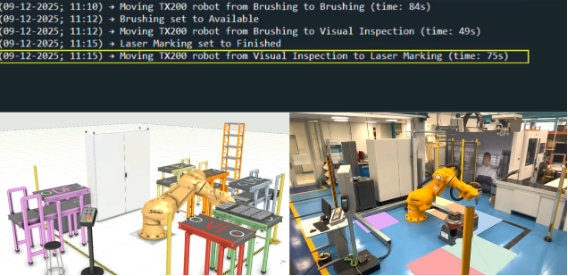
Virtual commissioning and real validation of the simulation.
Making complexity manageable
One of the most remarkable aspects of the solution is the successful implementation of Unidirectional Flow Control within a complex High-Mix, Low-Volume (HMLV) environment. While many automated systems struggle with variability, our solution manages over 1,000 distinct references in batch sizes ranging from single units to 2,000 pieces. How does this differ from the current state of the art?
From Static to Dynamic Planning: Most traditional factories in this sector plan operations on a weekly basis, leading to rigid and often outdated schedules. Our system, supported by the Digital Assistant, allows for a leap to bi-daily optimized re-planning. This 70% increase in agility enables the shop floor to react almost instantly to market shifts and urgent orders without disrupting the overall flow, while also contributes to reduced manufacturing time and energy consumption.
Optimized FIFO Logic: Unlike standard automated storage and retrieval systems that can be cumbersome to manage, our logic optimizes the sequence of requirements in real-time. This prevents the typical bottlenecks associated with high-variety production and ensures that "High-Mix" does not mean "High-Complexity" for the operator.
Scalable Efficiency: By automating the decision-making process for such a massive range of references, we have proven that high customization and high efficiency are no longer mutually exclusive. We have moved beyond the industry standard of manual oversight, delivering a truly responsive and autonomous finishing line.
The true legacy of this project lies in proving that high-end automation and Industry 4.0 standards are not exclusive to industrial giants. By implementing these solutions within the context of a Small and Medium Enterprise (SME), we have created a blueprint for agile, data-driven manufacturing that is both scalable and accessible. The impact of this use-case is best defined by its transformative metrics:
Responsiveness: We have shifted the planning cycle from 7 days to just 48 hours, increasing the company’s ability to react to market volatility by over 250%.
Operational Velocity: Internal material logistics have been slashed from 132 hours to 36 hours, representing a 72% reduction in non-value-added time.
Knowledge Democratization: The creation of a unified Digital Data Thread ensures that critical manufacturing intelligence is no longer siloed in the heads of a few experts but is accessible to the entire workforce.
Beyond the numbers, the legacy of this project is the future-proofing of an SME. We have demonstrated that with the right modular tools, like our Digital Assistant and automated flow control, a smaller player can manage a complex catalog of 1,000+ references with the efficiency and precision of a world-class smart factory. This success story is a powerful testament to how digital transformation can level the playing field in the European manufacturing landscape.